
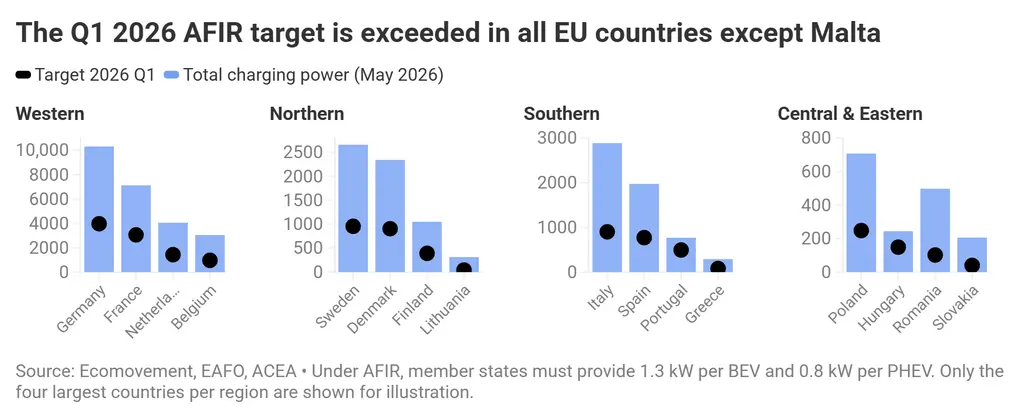
Reuters, citing analysis by Transport & Environment, reported that all EU member states except Malta had enough public charging capacity for the number of battery-electric cars on the road by the end of March 2026. The network reached about 1.1 million public charging points by the end of 2025—roughly five times the 2020 level.
Key facts
- The EU had about 1.1 million public charging points at the end of 2025, around five times the 2020 total.
- By June 2026, 79% of the TEN-T Core road network met the 2025 ultra-fast coverage target; the underlying analysis said 70 strategically placed stations could lift compliance to 90%.
Context and details
This development should be read in the wider context of a charging market that is changing quickly. A published proposal, a pilot, an adopted standard and an operational service are not the same stage. The original source therefore remains important for confirming the exact geography, timetable, participants, technical scope and any limitations that apply.
For drivers and property owners, the practical effect depends on more than the headline. Availability, connector compatibility, charging power, payment method, access hours, network capacity and maintenance all determine whether a new service or rule will be useful in everyday use. For a private installation, the electrical panel, cable route, protection, earthing and load management still need to be checked on site.
The analysis also shows that total capacity does not automatically mean perfect coverage. Ultra-fast charging on the main European transport corridors remained incomplete, so drivers may still encounter gaps on particular routes. For customers, the practical factors remain location, reliability, payment access and the real charging power accepted by the vehicle.
Why it matters
The useful lesson is to look beyond a headline number or announcement. A charging project must be checked for real operating status, available power, connector compatibility, payment access and maintenance. For a private installation, the electrical panel, cable route, protection, earthing and load management still determine the correct solution.
What it means in practice
For installation, regulation, pricing or route-planning decisions, open the original source and check whether a newer official update has been published.
What to verify before acting
Before planning a trip, buying equipment or ordering an installation, open the original publication and check whether a newer official update has appeared. Confirm that the information applies to the relevant location and vehicle, and distinguish between announced capacity and equipment that is already connected and available. This approach avoids decisions based only on a headline or an outdated number.