
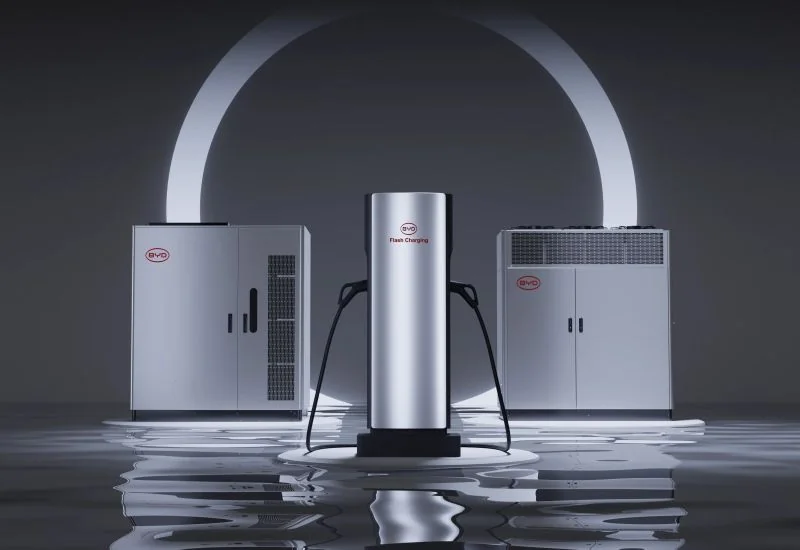
Geely, BYD, CATL and FAW are demonstrating battery systems that can add a large amount of charge in only a few minutes, but the results depend on very high-power compatible stations.
Key facts
- Lynk & Co demonstrated 10–70% charging in 4 minutes 22 seconds with Geely’s Golden Brick battery.
- BYD says its second-generation Blade platform can move from 10% to 70% in no more than five minutes.
- CATL reported commercial 20–80% charging in 6 minutes 48 seconds and is developing a faster passenger-car system.
- Peak charging power can approach 1.5 MW, so ordinary public chargers cannot reproduce the headline results.
The race to shorten charging stops
Chinese manufacturers are treating charging time as one of the main competitive battlegrounds for the next generation of electric cars. Recent demonstrations from Geely, BYD, CATL and FAW suggest that a useful highway charge could eventually take only a few minutes.
A Lynk & Co test using Geely’s Golden Brick battery reportedly reached 70% from 10% in 4 minutes 22 seconds. BYD has also announced a second-generation Blade system designed to cover the same range in five minutes or less.
Battery chemistry is only part of the system
Fast charging depends on the complete chain: battery cells, cooling, high-voltage architecture, charging cable and the power available from the station and local grid. A car capable of extreme charging speed will charge much more slowly when connected to a conventional 150 or 250 kW unit.
The published figures refer to controlled demonstrations and compatible equipment. They should not be read as the time every driver will obtain at every station or in every temperature.
CATL and FAW are also accelerating
CATL’s current commercial example was reported at 20–80% in 6 minutes 48 seconds. A future passenger-car battery is being developed for approximately 10–80% in 3 minutes 44 seconds, while FAW has shown a result only a few seconds slower.
These results illustrate how quickly the technical benchmark is moving, although durability, repeated fast-charge performance, cost and mass production remain just as important as a single record session.
What this means for charging infrastructure
Peak powers near 1.5 MW require heavy grid connections, advanced liquid-cooled cables and careful load management. Such stations will first make sense on major corridors, fleet hubs and locations with high utilisation.
For homes and ordinary workplaces, lower-power AC charging remains practical because vehicles stay parked for hours. Ultra-fast DC charging is complementary infrastructure for long-distance travel rather than a replacement for every home charger.