
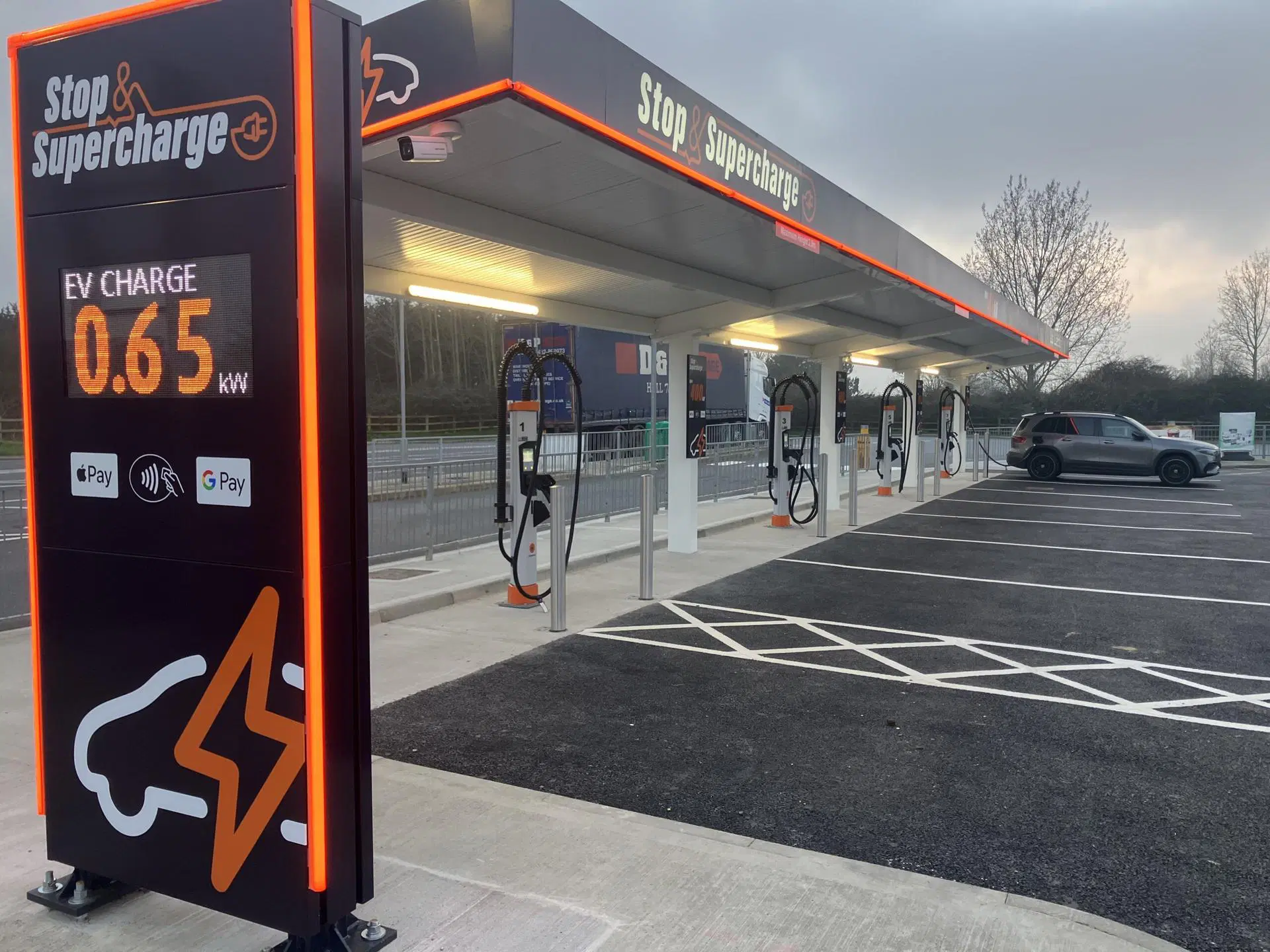
A service station on the A1 near Astwick has become Kempower’s first UK project financed through a leasing model designed to reduce the upfront cost of fast-charging infrastructure.
Key facts
- The Astwick site has eight CCS2 connection points supplied by four Kempower Double Satellites.
- Two modular Power Units can allocate up to 400 kW to a connected vehicle, subject to vehicle and site conditions.
- The project is Kempower’s first UK installation financed through its partnership with DLL.
- The financing package includes equipment and continuing maintenance, not only the initial hardware purchase.
Financing is becoming part of charging infrastructure
High-power charging sites require substantial spending on equipment, grid connection, civil works and long-term servicing. The Kempower–DLL model spreads part of the equipment cost over time, which can make deployment more accessible for independent service-station operators.
This does not remove the need for a viable location or sufficient electrical capacity. Operators still need realistic traffic forecasts, a suitable grid connection, permits and a maintenance plan.
What was installed at Astwick
The A1 northbound site uses four Double Satellite dispensers connected to two Power Units. Together they provide eight CCS2 charging points. The modular architecture dynamically distributes available power between connected vehicles.
Kempower states that a charger can receive up to 400 kW. Actual power depends on the vehicle battery, state of charge, temperature, simultaneous use and the power available at the site.
Maintenance is included in the model
The arrangement combines financing with regular maintenance support. For a public charging operator, uptime is as important as peak power: a high-rated charger that is unavailable does not serve drivers or produce revenue.
The site was commissioned in February 2026, while the financing project was announced in August. Hardware procurement, installation and long-term service were provided with infrastructure partner Yunex Traffic.
Why the project matters
The project shows that charging expansion is increasingly influenced by financing and service models, not just charger specifications. Leasing can help smaller operators enter the market without purchasing all equipment upfront.
For drivers, the practical result is more high-power locations. For owners of commercial sites, the lesson is to compare the complete lifecycle cost: grid work, civil works, payment systems, maintenance, software and future expansion.